











Iran's IRGC Vows Revenge as Succession Battle Begins in Tehran
Iran's IRGC pledged continued revenge operations Sunday as the Assembly of Experts began emergency deliberations to select a new supreme leader in Tehran.
IRGC Swears Revenge as Iran Faces Its Most Critical Succession in Decades
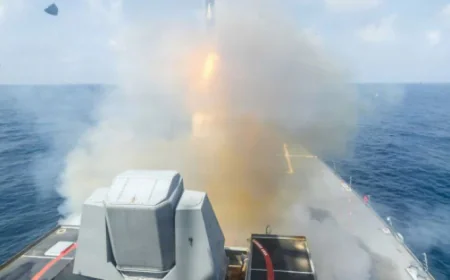
Iran's Islamic Revolutionary Guard Corps vowed Sunday to continue its attacks on US and Israeli targets until the killing of Supreme Leader Ayatollah Ali Khamenei has been "fully avenged." The IRGC's formal statement, broadcast on state television hours after Khamenei's death was confirmed, pledged that "the resistance will not stop until the enemy pays in full." Military operations against US bases across the Middle East continued through Sunday night.
At the same time, behind the scenes, Iran's political establishment launched its most consequential internal deliberation in decades. The Assembly of Experts — the 88-member clerical body constitutionally empowered to select a new supreme leader — convened in emergency session in Qom, Iran's religious capital, on Sunday afternoon. No public announcement has been made about candidates, and deliberations are being conducted in strict secrecy.
Khamenei's death leaves a leadership vacuum at the apex of a system specifically constructed around the principle of supreme religious authority. Unlike a Western democracy where institutional continuity is largely automatic, Iran's theocratic system depends heavily on the personal legitimacy and judgment of the supreme leader — a role that cannot simply be transferred by formula.
Competing Factions Eye the Succession
Three broad factions inside Iran's establishment are believed to be maneuvering for influence over the succession. Hardline IRGC-aligned clerics favor a candidate who will continue the confrontation with the West and maintain the revolutionary identity of the Islamic Republic. A second faction of pragmatic conservatives wants a figure capable of managing the economic crisis and potentially negotiating with the West under more favorable terms. A third, smaller group of reformists has little formal power but represents millions of Iranians frustrated with theocratic governance.
Several names circulated Sunday as potential candidates, including Mojtaba Khamenei, the supreme leader's son, and hardline cleric Ebrahim Raisi's political allies. Mojtaba Khamenei's potential candidacy is controversial — selecting a son would echo monarchical succession and directly contradict the Islamic Republic's republican and revolutionary rhetoric.
According to Ali Ansari, Professor of Iranian History at the University of St Andrews, "The succession is happening under uniquely terrible circumstances. Iran has never had to choose a supreme leader while actively at war. The person who emerges from this process will define whether Iran seeks to fight for years or finds a way to survive through negotiation."
Economic and Social Pressure Compounds the Crisis
Iran entered this crisis already economically battered. Years of US sanctions had crippled its oil revenues, crashed its currency, and produced unemployment rates — particularly among young Iranians — exceeding 25 percent in some provinces. The cost of the ongoing retaliatory strikes, the disruption to what remains of its civilian infrastructure, and the psychological shock of losing the supreme leader will compound those pressures enormously.
Street scenes in Tehran on Sunday were paradoxical — genuine grief among Khamenei supporters mixed with barely concealed relief or even celebration in some neighborhoods where resentment of the Islamic Republic runs deep. Social media inside Iran was heavily restricted but users found ways to share both mourning images and, in smaller numbers, expressions of hope that the regime change might open the door to a different future.
The question that will define Iran for years ahead is not just who becomes the next supreme leader — but whether any figure can command the authority, unity, and revolutionary legitimacy to hold the Islamic Republic together while managing an active war, an economic crisis, and the highest level of internal tension since the 2009 Green Movement.