




















GCC Foreign Ministers Hold Emergency Meeting Over Iran Crisis
Gulf Cooperation Council foreign ministers convened an emergency video conference Sunday to coordinate a unified response after Iranian missiles struck multiple GCC member states.
Gulf Nations Convene Emergency Session as Iranian Missiles Strike Member States
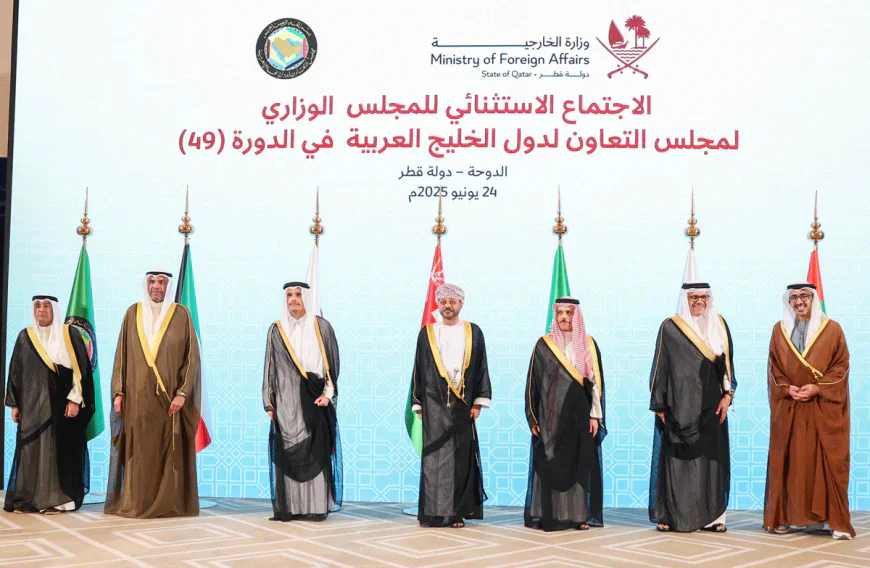
The Gulf Cooperation Council convened an emergency meeting Sunday. Foreign ministers from all six member states — Bahrain, Kuwait, Oman, Qatar, Saudi Arabia, and the United Arab Emirates — gathered by video conference to coordinate their response after Iranian missiles and drones struck targets across the region, shattering the Gulf's carefully maintained peace.
The meeting, confirmed by a Gulf diplomatic source to Al Jazeera, came after Iran's Islamic Revolutionary Guard Corps launched attacks on 27 US military bases in the region, including the US Navy's 5th Fleet headquarters in Bahrain and Qatar's Al Udeid Air Base, the largest US military installation in the Middle East. Manama's international airport was struck by a drone. Buildings in Bahrain's Seef commercial district were damaged.
Qatar confirmed that 66 missiles were fired at its territory on Saturday, with 16 people injured by falling shrapnel from intercepted projectiles. Saudi Arabia's Ministry of Defense confirmed interceptions of Iranian ballistic missiles headed toward Riyadh and the Eastern Province, home to the kingdom's oil infrastructure. No major oil facilities were reported damaged, but proximity was alarming.
GCC States Trapped Between US Alliance and Iranian Firepower
The Gulf states face a near-impossible strategic dilemma. All six host significant US military installations, making them legal targets under Iran's stated doctrine of striking American military positions in response to aggression. At the same time, all six have extensive economic and cultural ties with Iran and have no interest in being turned into a battlefield between Washington and Tehran.
Saudi Arabia and the UAE spent years building diplomatic back-channels with Iran after the 2023 China-brokered normalization agreement. Those channels are now under severe strain. Riyadh and Abu Dhabi issued measured statements Sunday calling for de-escalation "by all parties" — language carefully constructed to avoid either endorsing US actions or condemning them publicly.
According to Dr. Kristian Ulrichsen, Fellow for the Middle East at Rice University's Baker Institute, "The GCC states are fundamentally exposed right now. They cannot expel US forces — that would be a catastrophic strategic signal — but they also cannot absorb repeated Iranian strikes indefinitely without facing enormous domestic and economic pressure."
Airspace Closures Paralyze Regional Aviation
The practical disruption to Gulf daily life became visible almost immediately. More than 2,400 flights were canceled across Middle Eastern airports on Sunday, according to flight tracker FlightAware. Emirates, Qatar Airways, and Etihad — three of the world's busiest long-haul carriers — suspended dozens of routes and diverted flights mid-air.
Dubai International Airport, the world's busiest international hub, briefly suspended all arrivals Sunday morning before partially reopening with strict diversionary protocols. Qatar's Hamad International Airport operated at reduced capacity. Several major European airlines suspended their Middle East routes indefinitely pending a security assessment.
The economic cost of the airspace disruptions alone — compounding the oil price shock and regional tourism collapse — gives the GCC states powerful additional incentives to push for a ceasefire as quickly as possible, even as they lack the political leverage to force one on either Washington or Tehran.